

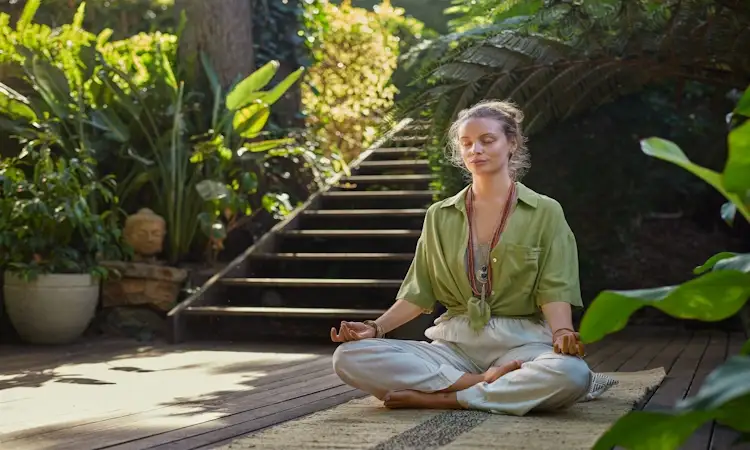
Ever notice how stress doesn’t stay in your head? It creeps into your jaw, shortens your breath, and turns your shoulders into stone. Then, even when you finally get a quiet moment, sitting still can feel impossible. Your mind keeps pacing, and your body feels stuck.
Somatic flow meditation is a gentle moving meditation that uses breath, slow movement, and body sensing to help settle the nervous system. No special gear, no perfect posture, and no need to “clear your mind.”
In this post, you’ll learn what the practice is (in plain English), why it can feel easier than still meditation, and a simple 12-minute routine you can try today. The goal is inner balance, that steady, present feeling where you’re less reactive and more grounded, even when life stays busy.
Somatic flow meditation, explained in plain English
Somatic flow meditation is a moving meditation practice where your attention stays inside the body while you move in small, comfortable ways. Instead of trying to think your way into calm, you sense your way there.
It blends three simple ingredients:
- Gentle movement, often repetitive and slow (like swaying, rolling shoulders, or shifting weight)
- Breath and movement meditation, where you let the breath guide the pace instead of forcing it
- Mindful body awareness practice, where you track sensations (pressure, warmth, stretch, pulsing) without judging them
If you’ve tried sitting meditation and felt more restless, you’re not alone. For some people, stillness can turn up the volume on stress. Movement gives the mind something steady to follow. It’s like handing a busy brain a simple job: “Feel the feet. Notice the breath. Move slowly.”
Over time, “inner balance” looks less like being calm 24/7 and more like recovering faster. You may notice you fall asleep more easily, or your mood swings feel less sharp. Focus can improve because your attention isn’t always yanked around by tension. Even small shifts count, like unclenching your teeth without thinking about it.
If you want a helpful framing of sensation-based mindfulness, Mindful has a solid guide on getting into the flow of sensations. The big idea is simple: sensations change, and noticing that change can steady you.
How it’s different from yoga, stretching, and sitting meditation
Somatic flow meditation can look like yoga or stretching from the outside, but the intention is different. You’re not “doing a pose.” You’re following sensation.
Here’s a quick way to tell them apart:
- Goal: regulation and steadiness, not performance or achievement
- Pace: slow enough that you can feel each small shift
- Attention: inside the body, not in a mirror or on how it looks
- Choice: you can pause, change, or stop at any moment
Flexibility doesn’t matter here. Strong muscles don’t matter either. You’re working in comfortable ranges, often much smaller than a typical workout. If a movement creates strain, you reduce it until your body says “yes.”
In contrast, stretching often chases sensation to the edge (that intense pull). Somatic flow meditation stays closer to the middle. Think of it like turning a dial instead of flipping a switch.
Why it calms the nervous system (without getting too science-heavy)
When your body senses safety, it can shift out of “fight or flight.” That shift doesn’t require a lecture or a perfect mindset. It often starts with simple signals.
Somatic flow meditation uses cues of safety, such as:
- a slightly longer exhale (without forcing a deep breath)
- gentle rocking or swaying that feels rhythmic
- feeling supported by the floor, a chair, or a wall
- soft eyes and an easy jaw
These cues can tell your system, “I’m here, and I’m okay right now.” As a result, your muscles may let go in small waves. Your breath may drop lower in the ribs or belly. Your thoughts can slow down because the body is less braced.
Research discussions around movement-based contemplative practices often point to this body-first pathway. If you want a deeper, academic overview of how mindful movement fits under the meditation umbrella, see this Frontiers perspective on movement-based embodied contemplative practices.
A helpful rule: if you can’t feel it, it’s probably too fast. Slow down until sensation becomes clear again.
A simple 12 minute somatic flow meditation you can do anywhere
Use this as a flexible script. You can do it standing, seated, or lying down. Keep movements pain-free and smaller than you think you need. If your mind wanders, that’s normal. Just return to one sensation, like the contact of your feet or the feeling of air leaving your nose.
A quick safety note: stop if you feel sharp pain, dizziness, numbness, or you start to feel overwhelmed. If strong emotions or trauma responses show up, consider practicing with a qualified mental health professional or a trauma-informed teacher.
Set up your space and choose an intention (1 minute)
Start by making it easy to succeed.
Wear comfortable clothes. Put your phone on silent. If you’re standing, keep a chair or wall nearby. If you’re seated, plant both feet on the ground. If you’re lying down, bend knees if your low back feels better that way.
Next, choose one small intention. Keep it short, like a single word or phrase:
- “Steady.”
- “Soft.”
- “I can slow down.”
Then ground yourself with contact. Feel your feet in your socks. Notice your thighs on the chair. Sense your back against the floor. Let that support matter.
Breath-led body scan and gentle rocking (3 minutes)
Let your breath be natural at first. No big inhale. No dramatic exhale. Just notice: where do you feel breath most clearly today, nose, throat, chest, or ribs?
Now do a simple scan, moving attention from top to bottom:
Forehead, eyes, jaw. Then neck and shoulders. Move down to chest and belly. Notice back, hips, thighs, knees, calves, ankles, and feet.
After the scan, add a small rocking or swaying motion.
If you’re standing, shift weight left and right like a slow pendulum. If you’re seated, gently rock your pelvis forward and back a few millimeters. If you’re lying down, you can sway knees side to side in a tiny range.
As you sway, let the exhale become a little longer than the inhale. Count if it helps, like in for 3, out for 4. Still, keep it easy.
If deep breathing makes you anxious, stay with smaller breaths. Focus on a softer exhale instead of more air.
Neck, shoulders, and spine flow for releasing built-up tension (4 minutes)
Keep your eyes soft. Then move as if you’re trying not to wake someone sleeping nearby.
- Shoulder rolls
Roll shoulders up, back, and down in slow circles. After a few rounds, switch direction. Track the sensations under the collarbones and around the shoulder blades. - Slow head turns (no circles)
Turn your head slightly right, then back to center. Go left, then center. Stop at the first sign of stretch. Your job is to sense, not to push. - Spine waves (cat-cow style)
Seated or standing, gently round your upper back as you exhale. Then let your chest float forward as you inhale. Keep it small. If your low back is sensitive, move mostly through the upper spine. - Gentle twist with breath
On an inhale, lengthen through the spine. On the exhale, rotate a little to the right. Inhale back to center, then exhale to the left. Feel how the ribs move against your shirt.
Throughout, keep checking: can you feel warmth, pressure, stretch, or pulsing? If sensation fades, slow down.
For more examples of simple body-based stress resets, Advanced Counseling Bozeman shares easy somatic exercises to reduce stress. Use ideas like those to build your own “tension release menu.”
Hips and legs flow for steadiness and grounding (3 minutes)
Inner balance often starts at the base. When your feet feel present, your mind usually follows.
Choose one option:
Standing option (chair-supported if needed)
Shift weight into the right foot, then into the left. Keep knees soft. Next, add slow heel lifts, rising a little, then lowering with control. Finish with tiny knee bends, like a mini squat, only a few inches.
Seated option
Make slow circles with your pelvis, as if drawing a small coin-sized circle on the chair. Then lift one heel and lower it, alternating sides. Feel the pressure changes under each foot.
Lying option
With knees bent, gently windshield-wiper your knees side to side. Keep your shoulders heavy. Notice when the low back contacts the floor more fully.
While you move, put 60 percent of attention in your feet or legs. Put the other 40 percent on breathing out. That blend often creates steadiness without trying.
Stillness, notice the after-effects, and close (1 minute)
Now stop moving. Let stillness arrive on its own.
Notice what’s different: temperature in your hands, tingling in the feet, a softer jaw, or a slower breath. Also check your eyes. Are they less strained? Does your forehead feel smoother?
Name one word for how you feel right now. Not how you think you should feel.
Then take a sip of water if you can, and return to your next task slowly. Even turning your head too fast can snap you out of the calm you just built.
Make it a real habit, even on busy days
A good somatic flow meditation routine doesn’t depend on motivation. It depends on being easy to repeat. Think of it like brushing your teeth. You don’t wait for the perfect mood. You do a small thing, often, and the benefits build.
Start by picking an “anchor time” that already exists in your day:
Morning works if you wake up tense or rushed. Midday fits if you feel your shoulders creep up during work. Bedtime helps if your body is tired but your mind won’t shut off.
Instead of tracking progress by minutes, track it by body cues. Ask: Did I unclench faster today? Did I sleep a little deeper? Did I snap less quickly at a small annoyance? Those are real wins.
Also watch for these common mistakes:
You’re moving too big, too fast, or too perfectly. In that case, shrink the range and slow down. Another mistake is forcing the breath. If you feel lightheaded, return to normal breathing and focus on contact with the floor.
Quick routines for different moments, from 2 minutes to 20
On packed days, use the minimum effective dose.
A 2-minute desk reset can be: feet on the floor, slow sway in the chair, one shoulder roll each direction, then three easy exhales that are slightly longer.
Before a meeting, try a 5-minute nervous system calming exercises set: stand, shift weight side to side, soften knees, and breathe out slowly while relaxing your tongue from the roof of your mouth.
On weekends, give yourself a 15 to 20-minute gentle somatic relaxation flow. Repeat the 12-minute sequence, then stay in stillness longer. Add a slow walk around the room if it feels good.
If you want another approachable moving meditation option, the Greater Good Science Center offers a clear how-to for walking meditation. It pairs well with somatic flow because both practices train steady attention through motion.
Common roadblocks (feeling silly, restlessness, emotions) and what to do
Feeling silly is common, especially at first. Make movements smaller, and keep your eyes open. Practicing near a wall can also help you feel supported.
Restlessness can show up when your body has stored energy. Instead of fighting it, give it a safe channel. Sway a bit more. Add heel lifts. Let the exhale slow you down after the movement starts.
Emotions can rise, too. If that happens, keep it simple: place a hand on your chest or belly, feel your feet, and look around the room to orient. Shorten the session and return to a single soothing motion, like gentle rocking.
If you feel flooded or panicky, stop the practice and choose support. A trauma-informed therapist or teacher can help you practice in a way that feels safe.
Conclusion
Somatic flow meditation is a simple embodied mindfulness technique that blends breath, gentle movement, and sensation tracking so you can feel steady again. It’s especially helpful when sitting still feels like too much, because the body gets to lead the mind toward calm.
Try the 12-minute flow once, then repeat it daily for a week. Notice what changes first, sleep, jaw tension, mood, or how fast you recover after stress.
Set aside a moment tomorrow, pick one intention word, then start with a gentle sway and a calm exhale. In somatic flow, inner balance often begins smaller than you think, and it begins in your body.

Gas S. is a health writer who covers metabolic health, longevity science, and functional physiology. He breaks down research into clear, usable takeaways for long-term health and recovery. His work focuses on how the body works, progress tracking, and changes you can stick with. Every article is reviewed independently for accuracy and readability.
- Medical Disclaimer: This content is for education only. It doesn’t diagnose, treat, or replace medical care from a licensed professional. Read our full Medical Disclaimer here.