

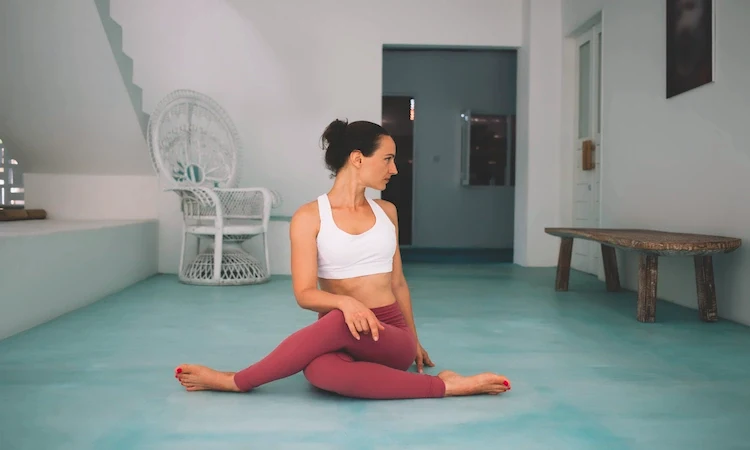
Your hips can feel like they’re “stuck” for a bunch of reasons, long desk days, hard workouts, stress, even a bad night’s sleep. One day you stand up and it’s like your hips forgot how to glide. Then your lower back joins the complaint line, and suddenly you’re stretching everything in sight.
Here’s the twist: hip tightness isn’t always a “short muscle” problem. A lot of the time it’s your nervous system keeping the area guarded. Somatic flow for hip tension is a gentle reset that uses slow movement and attention to help your body feel safe enough to let go. Think of it like easing a clenched fist open, not prying it.
In this post you’ll get a quick 2-minute self-check, a simple 10 to 12-minute somatic flow, and a few habits that help the release last. This isn’t medical advice. Stop if pain is sharp, numb, or worsening, and get help if anything feels alarming.
Suggestion:
This approach may be a good fit if your hips feel tight after long sitting, stress, or workouts, and stretching hasn’t helped you stay consistent. Somatic flow can also support you when stiffness keeps coming back.
It may not be the right choice if you have a new injury, recent surgery, or numbness or tingling, unless a qualified professional has cleared you first.
Why hips hold tension, and why forcing a stretch can backfire
Hips are a busy crossroads. They connect your legs to your pelvis, they influence how your lower back moves, and they’re loaded with muscles that react fast when you feel unstable. If your body senses “not safe” (from stress, fatigue, or a cranky joint), it often tightens the area to protect you.
That’s why forcing a stretch can backfire. If your brain reads the stretch as a threat, your body may clamp down harder. You might get a little range in the moment, then feel tighter later, or notice your low back taking over. It’s not that stretching is bad. It’s that intensity isn’t always the right first move.
It also helps to separate three different feelings that often get lumped together as “tight hips”:
- Tight muscles: they feel short, but they soften with warmth, slow reps, and time.
- Guarding: the area feels braced or jumpy, and your breath gets shallow when you push.
- Joint limits or irritation: you feel pinching, catching, or a sharp edge that doesn’t improve by pushing.
Somatic work is aimed at the guarding piece, the part that responds to safety cues. If you want context on how stress can feed pelvic pain and tension patterns, this overview of stress and pelvic floor tension lays out the connection in plain language.
The stress, sitting, and protection loop (glutes, hip flexors, and deep rotators)
Picture your hips like a tent held by ropes. Some ropes get slack from sitting, and others pull too hard to compensate. Long sitting keeps your hip flexors in a shortened position for hours. Your glutes, meant to help extend and stabilize the hips, can get “sleepy” and late to the party. Then smaller deep muscles in the back of the hip may brace to create stability.
Stress adds fuel. When you’re tense, your breathing often gets higher in the chest, your ribs move less, and your belly stays firm. That can ripple into pelvic tension, which can make the front of the hips feel guarded and the deep butt muscles feel clenched. Over time, your body can start treating normal motion (like standing tall, taking a longer stride, or squatting) as something it needs to control.
This is also where lower back tension can sneak in. If your hips don’t move with ease, your back often fills the gap. It’s like a coworker covering an extra shift, helpful at first, then burned out.
None of this means your body is failing. It often means your system is trying to keep you upright and moving. If you like a deeper explanation of how stress chemistry can affect pelvic pain reflexes, this Physiopedia article on stress and pelvic pain responses is a solid reference.
Signs your hips need calming first, not more intensity
If any of these show up, it’s a clue to go gentler before you go deeper:
- Pinching in the front hip during lunges, pigeon, or deep squats
- Holding your breath or feeling your throat tighten when you stretch
- Shaking, cramping, or gripping in the hip flexors or inner thighs
- Feeling “stuck” or more sore after stretching, instead of looser later
- Your low back takes over, arches hard, or feels jammed in hip openers
A clear safety note: if you have numbness, tingling, sudden weakness, pain that shoots down the leg, loss of balance that’s new, or bowel or bladder changes, pause the exercises and seek medical care. Those symptoms need a professional assessment.
A 2-minute self-check to find where your hip tension is coming from
Before you do any somatic release exercises, get a baseline. It keeps you honest. It also helps you notice progress that isn’t just “more stretch.” Sometimes the win is smoother motion, quieter breathing, or less bracing.
This self-check is gentle, no equipment, no sweating. Stay in a comfortable range. Aim for about 30 to 50 percent effort, like you’re moving through warm water.
If you want extra ideas for testing hip mobility at home, these simple hip mobility tests can help you compare left to right without overthinking it.
Baseline check: breath, pelvic position, and one easy hip motion
First, stand or sit tall.
Notice your breath for 3 cycles. Is it high in the chest, or can you feel the belly and ribs expand a bit? Don’t force a big inhale. Just observe.
Next, notice your pelvis. Does it feel tucked under (tailbone curled) or arched (butt back)? Many people live at one extreme without realizing it.
Now pick one gentle motion:
- Option A, lying down: pull one knee toward your chest slowly, then return it.
- Option B, seated: make a slow hip circle, like you’re drawing a small coin-sized circle with your knee.
Do 3 slow reps per side.
Rate your hip tightness from 0 to 10, then note where you feel it most: front hip, outer hip, deep butt, or low back. You’ll re-check after the flow.
Quick interpretation: what front hip vs outer hip vs deep butt tightness can mean
This isn’t a diagnosis, it’s a way to aim your attention.
If you feel it in the front hip, it can mean hip flexor guarding, or a habit of standing and moving with the pelvis tipped forward. It can also be a sign you’re pushing into a range your body doesn’t trust yet.
If you feel it on the outer hip, it often points to the side hip working overtime to stabilize you, sometimes after lots of sitting, running, or single-leg training. The area may be tired, not “tight.”
If it’s in the deep butt, the rotators may be bracing, and some people also notice pelvic floor tension tagging along. Stress can amplify that. For a calm, practical explanation of the nervous system connection, see this pelvic floor and nervous system guide.
If your low back lights up, it can mean your hips aren’t sharing the work, or you’re moving fast and skipping the stabilizers.
Somatic flow for hip tension: a gentle reset you can do in 10 to 12 minutes
This is the main practice. The goal is not to force flexibility. The goal is to teach your body that hip motion is safe again. That’s why it’s slow, small, and steady.
Keep the effort around 30 to 50 percent. If you’re used to intense stretching, this may feel almost too easy. Good. Easy is often what helps your nervous system change its mind.
You’ll also get better results if you think “smooth” instead of “deep.” Less range often works better for hip tightness relief.
Set up for success: comfort, breathing, and a pain rule
Set up on a mat or carpet, or even your bed if the floor feels harsh. Lie on your back with a pillow under your head. Bend your knees, feet on the surface, hip-width apart.
Take 3 slow breaths. Let your exhale be a little longer than your inhale. Unclench your toes. Relax your hands. Let your jaw soften, teeth slightly apart.
Use one clear pain rule: no sharp pinch, no zinging, no breath-holding. A mild stretch or effort is fine. If you feel a sharp edge in the front hip, make the movement smaller, slow down, or skip that step.
The flow sequence: pelvic clock, knee folds, hip roll, and gentle rocking
Move like you’re trying not to spill a full mug of tea resting on your belly.
- Pelvic clock (30 to 60 seconds)
Keep your shoulders relaxed. Gently tilt your pelvis so your low back softly presses down, then tip the other way so there’s a small arch. Go back and forth slowly.
Then shift side to side, like you’re moving your belt line left and right. Keep it small. - Supine marching knee folds (6 each side)
Keep both knees bent. On an exhale, lift one foot just a few inches, like a tiny march. Inhale as you lower it.
Let your belly stay soft. If your hip flexors grab, make it smaller, or slide the foot along the floor instead of lifting. - Figure-4 hip roll (30 seconds each side)
Cross your right ankle over your left knee (only if it’s comfortable). Don’t pull anything in.
Now sway your hips a tiny bit side to side, as if your legs are a hammock. Keep the range small. Your job is to notice where you brace and then back off a touch.
Switch sides.
Modification ideas: keep the bottom foot closer to your hips, place a pillow under the crossed leg for support, or skip figure-4 if you feel front-hip pinching.
- Knees-together windshield wipers (6 to 10 total)
Place your feet a little wider than hips. Bring knees together gently.
Let both knees tip a few inches to the right, then back through center, then a few inches to the left.
Keep shoulders heavy. If your low back feels like it’s doing everything, make the movement smaller and slower. - Choose one finish (30 to 60 seconds)
- Knees-to-chest rocking: hug behind the thighs and rock a few inches side to side.
- Happy baby variation: hold behind the thighs with knees bent, feet up, and gently sway. Skip grabbing the feet if that makes you strain.
Throughout the whole flow, keep returning to the simplest cue: easy exhale, soft face. That’s how you tell your nervous system and hips they can stand down.
If you want more examples of gentle, awareness-based hip work, this guide on chronic hip pain and somatic approaches offers extra background and ideas.
Finish and re-check: how to tell the reset worked
After the last move, rest still for 20 seconds. Feel the back of your pelvis heavy. Notice if your breath drops lower on its own.
Now repeat your baseline motion, the knee-to-chest or the seated hip circle. Re-rate tightness from 0 to 10.
“Better” might mean less gripping, smoother movement, or a quieter low back, even if your range looks the same. Warmth in the hips can also be a good sign. Your body is responding, not being forced.
Make the release last: simple habits that reduce hip tightness day to day
A good reset can fade fast if the rest of your day tells your hips to brace again. The goal isn’t perfect posture or constant stretching. It’s giving your system frequent reminders that you’re safe and you can move.
Think of it like brushing your teeth. Small, consistent inputs beat one big session you dread.
This is where gentle mobility hips work best: short bouts, low effort, done often.
Micro moves for desk days and workouts (60 seconds at a time)
Set a timer a couple times a day, or link these to habits you already do (coffee, bathroom breaks, warming up).
- Stand and shift weight side to side, slow and easy, 6 to 10 shifts.
- Do slow hip circles while standing, small range, both directions.
- Try a short lunge hold with an easy breath, stay high, don’t sink.
- Squeeze your glutes for 2 seconds, then fully relax, repeat 5 times.
- Take a 1 to 3-minute walk, even if it’s just around your home.
Frequent gentle motion teaches your body that hip movement is normal again. One long stretch can’t compete with eight hours of stillness.
When to progress, and when to keep it gentle
Progress works best when your body is already calm. If the flow leaves you feeling looser and more steady, you can build slowly:
Add a second round of the flow, use a slightly bigger range, or add a light strength move after, like 2 sets of short bridge holds (5 slow reps), with relaxed breathing.
Stay gentle when stress is high, sleep is poor, you’re in a pain flare, or your legs are heavily sore. On those days, your nervous system is already loaded, and pushing often adds guarding.
A simple schedule that works for many people: 10 minutes, 3 to 5 days a week, with a quick before-and-after re-check. Tracking sensations (not just range) helps you learn what your hips respond to.
Conclusion
Hip tension isn’t always a flexibility problem. Often, it’s protection, your system trying to keep you stable when stress, sitting, or training load piles up. Somatic flow for hip tension helps by sending safety signals through slow motion, easy breath, and low effort, so your hips can stop gripping and start gliding.
Do the 10-minute reset once today, then re-check your baseline. Pay attention to what shifts, even small changes in your somatic flow. If the symptoms feel sharp, shooting, or numb, or they don’t ease over time, contact a qualified clinician for a full assessment and support.

Gas S. is a health writer who covers metabolic health, longevity science, and functional physiology. He breaks down research into clear, usable takeaways for long-term health and recovery. His work focuses on how the body works, progress tracking, and changes you can stick with. Every article is reviewed independently for accuracy and readability.
- Medical Disclaimer: This content is for education only. It doesn’t diagnose, treat, or replace medical care from a licensed professional. Read our full Medical Disclaimer here.