

You know the feeling. Day one is perfect. You drink the water, do the workout, read the pages, and go to bed proud. Then a busy morning hits, or you get home tired, and the plan falls apart. A week later, you’re back at zero, telling yourself you “just need more discipline.”
A micro habit tracker fixes a different problem. It doesn’t try to pump you up. It helps you stay connected to one tiny action, even when motivation is gone.
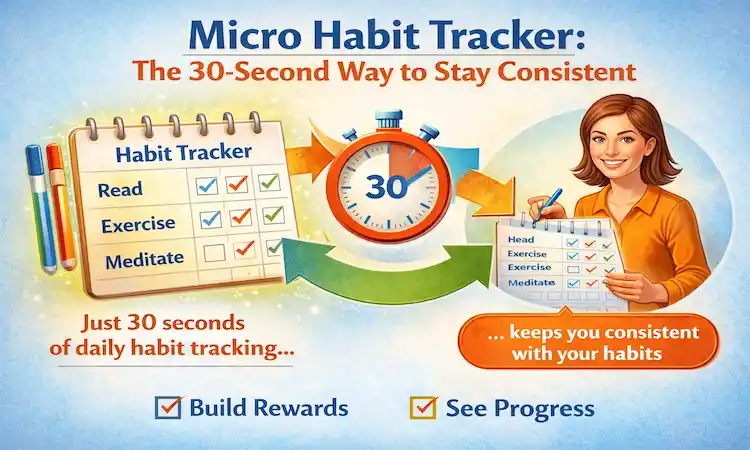
In one sentence: a micro habit tracker is a simple way to mark “I did the smallest version today.” The payoff is big, you keep showing up without pressure, even on rough days. The whole system takes about 30 seconds a day, needs no app, and works whether you track one habit or a few.
Why tracking tiny habits works when big plans fail
Big plans fail for boring reasons. Not because you’re lazy, but because life has friction. You wake up late. Your kid is sick. Your brain is full. Your calendar gets loud. When that happens, motivation turns into a flaky friend who “can’t make it.”
Systems are different. A system doesn’t ask, “Do you feel like it?” It asks, “What’s the smallest thing we do no matter what?” That’s where a micro habit tracker shines. It keeps the habit small enough to happen on a bad day, and it gives you a quick visual nudge that says, “This matters.”
Tracking also cuts down on decision fatigue. If you’ve ever stared at your to-do list and felt your mind go fuzzy, you’ve felt it. Micro tracking removes the daily debate. You don’t have to choose the perfect time, the perfect workout, or the perfect plan. You do the tiny version, then you mark it.
There’s another quiet benefit: you build trust with yourself. Every checkmark is a small promise kept. That’s why habit tracking simple methods often beat “perfect” systems that take too much effort to maintain. If you want a deeper look at why tracking works, James Clear lays out the logic and practical methods in his habit tracker guide.
The 2-minute rule, but even smaller: pick a habit you can do on your worst day
The “2-minute rule” is a good start, but micro habits go even smaller. The point isn’t to impress anyone. The point is to make the habit almost impossible to skip.
Ask yourself: what could you do when you’re tired, annoyed, and short on time?
Examples of “worst day” habits:
- Drink a few sips of water.
- Do 5 squats.
- Open a book and read one paragraph.
- Write one sentence in a notes app.
- Put one dish in the dishwasher.
- Floss one tooth.
That last one sounds silly, and that’s why it works. This is the “minimum version” concept. You’re not quitting on your goal, you’re building a bridge to it. When you remove the all-or-nothing standard, you stop treating a hard day like a personal failure.
If you want another explanation of the 2-minute idea (with real-life framing), this article breaks it down clearly: The 2-Minute Rule: The Secret to Sticking With New Habits.
Habit streaks without stress: measure effort, not perfection
Many people quit tracking because they miss a day and feel like they “ruined the streak.” That’s a mindset problem, not a habit problem.
A tracker should measure effort, not perfection. One missed day doesn’t erase your progress, it just shows you’re human. The goal is to notice slips early, while they’re still small.
A helpful rule is “never miss twice.” Miss Monday, fine. Your only job is to show up Tuesday, even if it’s the minimum version. A micro habit tracker makes this visible. It’s not a judge, it’s a smoke alarm. It tells you when the habit is starting to drift so you can correct fast, without drama.
Build your 30-second micro habit tracker (paper, notes app, or calendar)
A tracker only works if it’s easy to update. If tracking takes longer than the habit, you’ll stop. If it requires a perfect layout, you’ll “fix it later” until it disappears.
So keep it plain. Think of your tracker like a sticky note on a fridge, not a scrapbook project.
Here are three ways to track habits without apps (plus apps as an option if you like them). Each takes seconds.
A simple example layout, described in words: write your habit at the top (like “Read 1 paragraph”), then draw seven small boxes for the week (or write the days: M T W T F S S). Each day you do the habit, you add a dot or check. That’s it. You’re done.
If you enjoy paper systems, College Info Geek has a solid breakdown of a paper habit-tracking system that stays practical instead of decorative.
Step 1: Choose one habit, then write the smallest “done” definition
Start with one habit. Seriously, one. When you begin with three or five, the tracker becomes a tiny guilt machine. Consistency comes from wins that feel easy.
Pick a habit that matters right now. Not forever, just now.
Use this quick filter before you commit:
- Does it take under 2 minutes?
- Can I do it at home?
- Can I do it tired?
- Can I do it with zero prep?
Then write your “done” definition in a way that leaves no wiggle room. Good “done” definitions are almost comically small.
Strong examples:
- “Brush teeth, then floss one tooth.”
- “Put on walking shoes.”
- “Open the journal, write one sentence.”
- “Do 5 squats next to the bed.”
- “Read one paragraph.”
This is where people get stuck because they think small means pointless. It doesn’t. The tiny action is the seatbelt, not the road trip. Once you’re strapped in, you often do more, but you never require it.
Step 2: Pick a tracker style that takes seconds to update
Choose a format you’ll actually use when you’re half-asleep or rushing out the door. Pretty is optional. Fast is required.
Option 1: Paper (sticky note or index card)
Write your habit at the top. Draw 7 boxes. Put it somewhere you can’t ignore, like the bathroom mirror or next to the coffee maker. Each day gets one checkmark.
Option 2: Notes app checklist
Create a note titled “Micro habit.” Add your habit and seven blank lines under it (or a simple checklist). Each day, type a single character like “x” or “.” The goal is speed, not formatting.
Option 3: Calendar X marks
Use any calendar you already look at, paper or digital. Write a short habit label on the month (like “water” or “read”). Mark an X on days you did the minimum. This works well for people who hate lists.
If you want app-based habit tracker ideas, keep the bar the same: it should be quick and low-friction. Zapier’s roundup of the best habit tracker apps in 2025 can help you compare options without falling into endless browsing.
Step 3: Add one quick cue so you remember to track
Most tracking fails for one reason: you forget. Not forever, just often enough to break the chain.
Fix that by pairing tracking with something you already do. A cue is a physical or visual reminder that puts the tracker in your path.
Practical cue ideas:
- Place the index card next to your toothbrush.
- Put a sticky note on the coffee maker.
- Make the note the first item on your phone’s home screen.
- Put the tracker on top of your laptop keyboard.
- Tape the note to your nightstand.
Keep it low effort. If setting up the cue becomes a project, you’ll avoid it. The best cue feels almost too simple, like leaving your keys on top of your lunch so you can’t forget it.
Use the tracker like a coach, not a judge (so you keep going for months)
A micro habit tracker should feel like a friendly coach with a clipboard, not a strict teacher with a red pen. The moment tracking becomes punishment, you’ll start hiding from it.
That’s why a weekly review matters. Not a big journaling session. Just two minutes, once a week, to notice what’s working and adjust what’s not.
This is also how you grow the habit without losing it. When the minimum version feels automatic, you can expand it gently. “Read one paragraph” becomes “read one page” because you want to, not because you’re trying to earn your checkmark.
If you like the idea of reviewing patterns in your behavior, James Clear’s Habits Scorecard exercise is a useful companion. It’s built around awareness first, then change.
Here’s a tiny consistency checklist to keep your tracker helpful:
- Did I define “done” small enough?
- Is my tracker easy to see?
- Can I update it in under 30 seconds?
- If I miss, do I restart with the minimum?
A weekly habit scorecard: 3 questions that keep you on track
Once a week (Sunday night, Monday morning, whenever you’ll remember), ask:
- What helped me do it?
- What got in the way?
- What is one small change for next week?
Answer in one sentence each. You’re not writing a memoir.
Then take one tiny action based on what you learned. If you forgot, move the cue. If evenings were chaotic, switch to mornings. If the habit felt heavy, shrink the “done” definition.
This turns tracking into feedback instead of judgment. You’re running a simple experiment, and the tracker is your data.
Common snags and quick fixes that take less than 5 minutes
Snags are normal. Plan for them, and they stop being dramatic.
Missed days: Restart with the smallest version. Your job is to get a win today, not to “make up” for last week.
Too many habits: Cut back to one. When one habit is stable, add another.
Tracker fatigue: Switch formats. Move from paper to calendar, or from a notes app to a sticky note. A fresh format can reset your attention.
Travel or weird schedules: Keep a backup note on your phone labeled “Minimum done.” If you’re out of routine, the phone is usually still with you.
Perfectionism: Count “minimum done” as a real win. If the definition was “one paragraph,” don’t move the goalpost and call it a failure because you didn’t read ten pages.
If you want inspiration for micro-focused tracking in an app format, the Play Store listing for Micro Habits: Self-Improvement shows the kind of lightweight approach that pairs well with minimum habits.
Conclusion
Consistency isn’t built by heroic days. It’s built by regular days, including the messy ones. A tiny habit plus a tiny tracking method is a quiet formula that keeps working, even when your schedule doesn’t.
Your micro habit tracker only has two jobs: make the habit easy to complete, and make it easy to notice when you’re drifting. Treat it like a coach, and it’ll help you rack up habit streaks without stress.
Pick one micro habit today, write your “done” definition so small it feels doable anywhere, then set up your tracker. Mark your first check now, and let consistency start with something you can finish in under two minutes.

Gas S. is a health writer who covers metabolic health, longevity science, and functional physiology. He breaks down research into clear, usable takeaways for long-term health and recovery. His work focuses on how the body works, progress tracking, and changes you can stick with. Every article is reviewed independently for accuracy and readability.
- Medical Disclaimer: This content is for education only. It doesn’t diagnose, treat, or replace medical care from a licensed professional. Read our full Medical Disclaimer here.