

You know the feeling: you want better habits, but your day is already full. You tell yourself you’ll work out, read more, drink water, or plan your day, then life happens and it slips again. It’s not that you don’t care. It’s that the habit has too much friction.
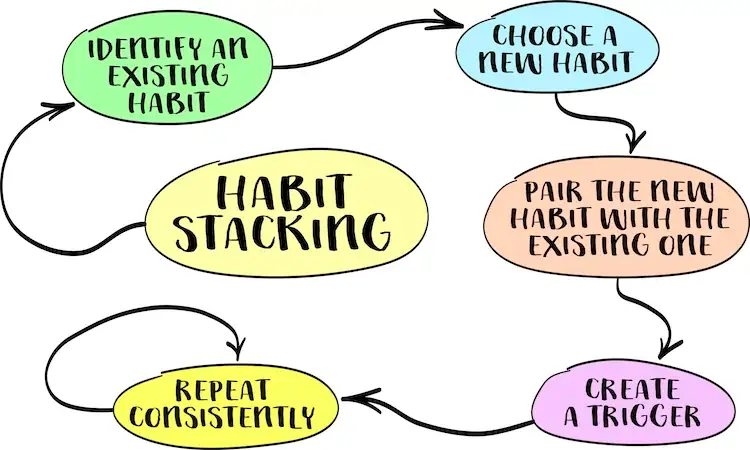
That’s where Habit Stacking Micro Habits can help. Habit stacking means you attach a new tiny habit to something you already do, so the old habit becomes the trigger for the new one.
Micro habits work because they’re small enough to repeat even on messy days. They don’t ask you to “get motivated,” they ask you to do something so easy you almost can’t talk yourself out of it. In this post you’ll get reliable anchor habits (morning, daytime, evening), clear habit stacking examples you can copy, and a simple way to build a stack that lasts.
How habit stacking micro habits works (and why anchors matter)
Habit stacking is simple: you stop trying to “find time” for a new habit, and you connect it to a habit that already exists. Your current habit becomes the anchor, and the new behavior becomes the add-on.
The most common format is:
After I do X, I will do Y.
- X is the anchor habit, something you already do regularly.
- Y is the micro habit, the tiny action you want to add.
A micro habit should take under 2 minutes at first. That’s not a random rule, it’s a practical one. Two minutes is short enough that you can do it when you’re tired, rushed, or annoyed. The goal early on isn’t self-improvement. The goal is repetition.
Anchors matter because they beat willpower in a fair fight. You might forget a new habit, but you probably won’t forget to brush your teeth, make coffee, or plug in your phone. A good anchor shows up whether you feel inspired or not. That’s why the method described in James Clear’s habit stacking guide clicks for so many people. It rides on routines you already run on autopilot.
Here’s a real-life example that stays small on purpose: after you lock your front door when you leave, you do one posture check (shoulders down, jaw unclenched). It takes 5 seconds. It’s also tied to a moment that happens almost every day, in the same place, with a clear end point (click, door locked). That’s the magic: a dependable trigger plus a tiny action.
The simple formula: “After I do X, I will do Y”
The sentence is easy, but the details matter. The more specific the anchor and the micro habit, the more likely you’ll do it.
Try writing your own like these:
After I put my coffee mug in the sink, I will drink 6 gulps of water.
After I sit down at my desk, I will write one next step for my top task.
After I wash my hands, I will do 3 slow breaths.
After I get into bed, I will text one kind message to someone I care about.
Notice what’s missing: big promises. Each “Y” is so small it feels almost too easy. That’s the point. If you’re thinking, “That’s not enough to change my life,” good. You’re building the base layer first.
What makes a great anchor habit (and what makes a bad one)
A strong anchor habit has a few traits you can trust:
- Already daily (or near-daily): you don’t want to wait three days for the trigger.
- Same place, same context: the brain likes consistency.
- Clear end point: “finish brushing,” “close laptop,” “turn off alarm.”
- Hard to skip: not a “nice-to-have,” it’s part of your day.
- Not rushed: if you’re always sprinting through the moment, it’s a shaky base.
Weak anchors tend to be vague or unstable, like “after work” (when, exactly?), “when I have time” (rare), or “after I get home” (what if you run errands first?).
Quick anchor checklist: if you can answer when, where, and what exact moment ends it, you’ve probably found a good one.
The best anchor habits to stack onto (morning, daytime, and evening)
When people say habit stacking “didn’t work,” they usually chose a messy anchor. They picked something that changes daily, or they anchored to a time block instead of an action.
Below are dependable anchor habits you can use as triggers, plus micro habit ideas that pair well. Keep your first micro habit so small it feels safe. You’re not trying to build the perfect routine, you’re trying to build routines that stick.
If you want extra context on why stacking helps habits feel more automatic, Calm has a clear breakdown in why habit stacking can help routines stick.
Morning anchors that happen almost every day
| Morning anchor habit | Micro habit idea (pick one) |
|---|---|
| Turn off alarm | Drink a few sips of water you left by the bed |
| Feet hit the floor | 3 deep breaths, slow and quiet |
| Bathroom break | Apply sunscreen to face (one step, not a full routine) |
| Brush teeth | Floss one tooth (yes, one) |
| Start coffee or tea | Write one priority on a sticky note |
| Feed pets | Open blinds for daylight, or step outside for 20 seconds |
Morning anchors work well because they’re repeatable. They also happen before you’ve made a hundred choices, so the “decision tax” is low.
Daytime anchors that fit work, school, or staying at home
| Daytime anchor habit | Micro habit idea (pick one) |
|---|---|
| Sit down at desk or table | 20-second desk reset (one item back where it belongs) |
| Open laptop | Write one sentence plan: “Next, I will…” |
| Start a meeting or class | Relax shoulders, unclench jaw, breathe once slowly |
| Microwave lunch | Add one healthy item (fruit, yogurt, salad kit) |
| Refill water bottle | Take 10 slow sips before walking away |
| Plug in phone to charge | Send one important message you’ve been avoiding |
Daytime anchors are great for “maintenance habits,” the ones that keep life from getting chaotic. They’re also the best place to add micro habits that reduce stress, like tiny resets and quick planning.
Evening anchors that make nights calmer and mornings easier
| Evening anchor habit | Micro habit idea (pick one) |
|---|---|
| Finish dinner | Put leftovers into one container (not the whole kitchen) |
| Load dishwasher | Wipe one counter section for 20 seconds |
| Take a shower | Lay out clothes for tomorrow |
| Put kids to bed | Write one win from the day on a note app |
| Set alarm | Put phone on charger outside the bed if possible |
| Lock the door | Turn off one light, or start a 2-minute tidy timer |
Evening anchors help because they reduce tomorrow’s friction. One small action at night can feel like a gift to your morning self.
Habit stacking examples you can copy (and how to make them your own)
Stealing a working stack is fine. The key is shaping it to your life so it doesn’t feel like a stranger’s routine glued onto your day.
A good stack has two qualities: it’s anchored to actions that already happen, and it stays small enough that you don’t need a “perfect day” to do it. If you’ve struggled with consistency, BetterUp’s explanation of what habit stacking is and examples supports the same idea: structure beats intention.
One more rule that keeps stacks from collapsing: only level up after it feels automatic. That usually means the micro habit happens without a debate in your head. When it’s easy, add time or add one more step. Not before.
Also, customize for your schedule. If you work an early shift, your “morning” might start at 4:30 a.m. If you’re a parent, your first anchor might be “after I pour cereal” or “after I buckle the car seat.” If you’re a student, it might be “after I open my notes app.”
Morning micro habit stacks for energy and focus
Stack 1 (hydration plus light)
After I turn off my alarm, I will drink 6 gulps of water.
After I drink water, I will open the blinds.
After I open the blinds, I will take 3 slow breaths.
Level up after 2 weeks: take a 3-minute walk to the mailbox, or step outside for 2 minutes.
Stack 2 (wake up the body, gently)
After I brush my teeth, I will do 10 seconds of tall posture.
After I do posture, I will do 5 wall push-ups (or 5 air squats).
After I do that, I will put on my walking shoes.
Level up after 2 weeks: keep the shoes on and walk 5 minutes.
Stack 3 (plan the day without overthinking)
After I start coffee or tea, I will write one priority.
After I write one priority, I will write one “tiny start” step.
After I write the tiny step, I will open the app or document I need.
Level up after 2 weeks: add a 2-minute timer and work until it ends.
These stacks give you energy and focus without demanding a full morning routine. They also create a quick “start signal” for your brain: we’re awake, we’re moving, we have a plan.
Evening micro habit stacks for better sleep and less stress
Stack 1 (close the kitchen)
After I finish dinner, I will put leftovers in one container.
After I put leftovers away, I will fill the sink with soapy water.
After I fill the sink, I will wash one item (or load five dishes).
Level up after 2 weeks: finish the sink, but keep the time cap small (5 to 7 minutes).
Stack 2 (prep tomorrow in tiny steps)
After I take a shower, I will lay out clothes for tomorrow.
After I lay out clothes, I will set my keys or bag by the door.
After I set them down, I will set the coffee maker or kettle.
Level up after 2 weeks: add “check calendar for 30 seconds.”
Stack 3 (under 2 minutes total for busy nights)
After I plug in my phone, I will put it face down.
After I put it face down, I will write one win from today.
After I write the win, I will read one page of a book (or one paragraph).
This last one is for the nights when you’re running on fumes. It still shifts your brain toward calm, and it keeps your identity as “someone who follows through” alive.
Micro habit stacks for health, money, and relationships
Health, money, and relationships often fail on the small moments, not the big plans. Stacks help because they show up inside your day, not outside it.
Health stack (meds plus teeth)
After I pour my morning drink, I will take my meds (if prescribed).
After I take my meds, I will floss one tooth.
After I floss, I will rinse and put floss where I can see it.
Money stack (make money habits boring)
After I sit down at my desk, I will open my bank app.
After I open it, I will check balances for 20 seconds.
After I check, I will move $1 to savings (or schedule one bill).
Relationship stack (small bids for connection)
After I sit down on the couch, I will send one “thinking of you” text.
After I send it, I will say one specific compliment to my partner or roommate.
After I say it, I will put my phone down for 60 seconds and listen.
If these feel too easy, good. Easy means you’ll repeat them. Repetition is where change starts.
Conclusion
Habit stacking works when you stop treating habits like a motivation test. Pick a strong anchor habit, attach a micro habit that takes under 2 minutes, and use the simple script: After I do X, I will do Y. Then repeat until it feels automatic.
Start with one stack for seven days. Don’t build a long routine on day one. Let your brain learn the sequence, like a short song you can’t forget.
Tonight, choose one anchor from the lists above, write one sentence, and try it tomorrow. Keep it tiny, keep it consistent, and let micro habits do what they do best: quietly add up.

Gas S. is a health writer who covers metabolic health, longevity science, and functional physiology. He breaks down research into clear, usable takeaways for long-term health and recovery. His work focuses on how the body works, progress tracking, and changes you can stick with. Every article is reviewed independently for accuracy and readability.
- Medical Disclaimer: This content is for education only. It doesn’t diagnose, treat, or replace medical care from a licensed professional. Read our full Medical Disclaimer here.